
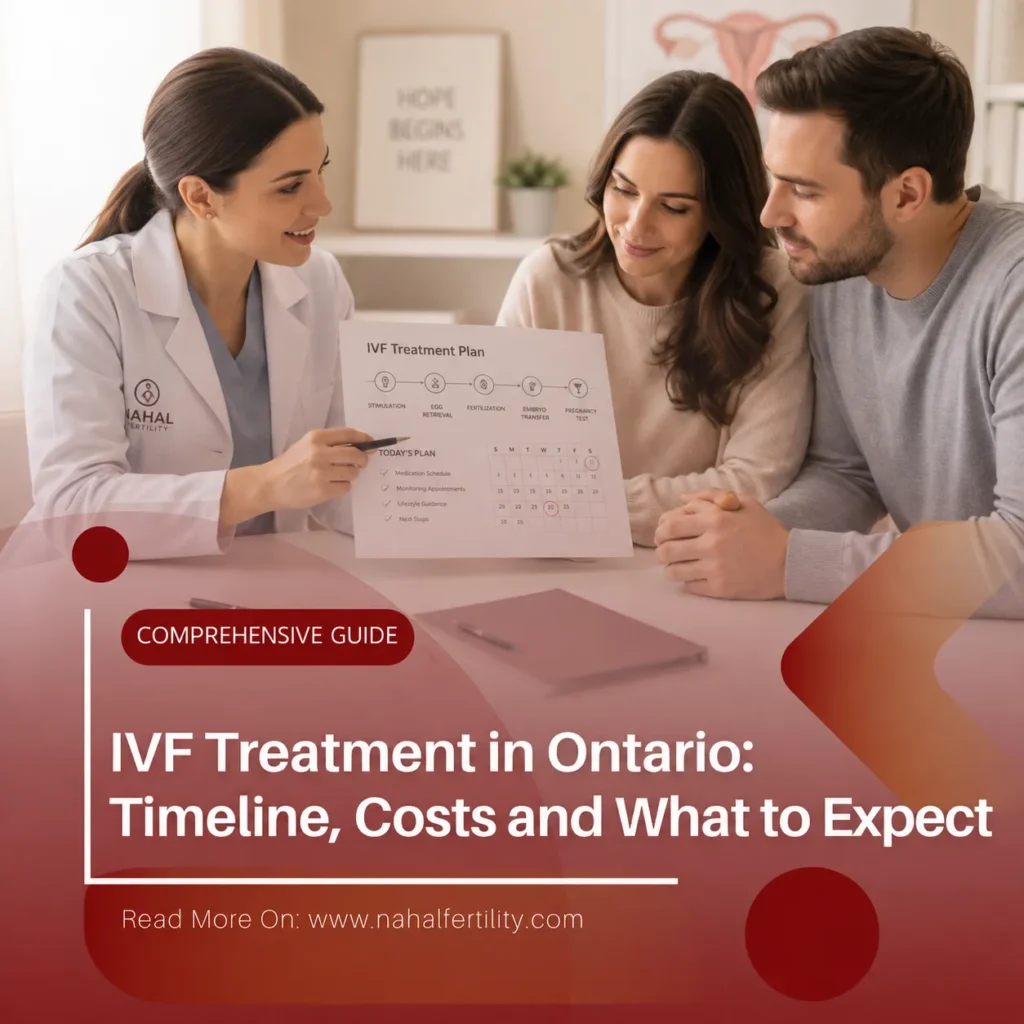
Planning IVF treatment in Ontario is easier when you understand the likely timeline, expected costs and services that may remain out of pocket. Although the core steps are similar across IVF clinics, the schedule varies based on age, test results, diagnosis, ovarian response, sperm factors, genetic testing and whether treatment includes a frozen embryo transfer.
Ontario expanded access to publicly funded fertility care for 2026/27, and the refundable Ontario Fertility Treatment Tax Credit may help offset eligible expenses. Below, we follow the process from the first consultation through pregnancy testing and highlight the questions to raise before treatment begins.
Before looking at each stage in detail, it helps to understand the overall timeline and the costs you may need to plan for:
| A straightforward IVF cycle often takes four to six weeks from the start of ovarian stimulation to the pregnancy test. Preliminary testing, cycle preparation, embryo genetic testing or a planned frozen transfer can extend the timeline.
For private treatment, a practical planning range is about $10,000 to $20,000 per cycle in Ontario. The total depends on medications, laboratory services and optional procedures. A publicly funded cycle may cover major treatment services for eligible patients, but medications and certain additional services may remain out-of-pocket. |
What Is IVF Treatment and Who May Benefit?
In vitro fertilization, or IVF, is an assisted reproductive treatment in which eggs are collected from the ovaries and fertilized with sperm in an embryology laboratory. After fertilization and embryo development, a suitable embryo may be transferred to the uterus, while other suitable embryos may be frozen. The phrase “in vitro” means “in glass,” referring to fertilization outside the body. The term “in vitro reproduction” also appears in online searches, although “in vitro fertilization,” or IVF, is the standard medical term.
IVF may be considered after other approaches have not worked or when testing shows that a more direct treatment is appropriate. Common reasons include blocked fallopian tubes, significant male-factor infertility, endometriosis, ovulation disorders, reduced ovarian reserve, age-related fertility changes, unexplained infertility or unsuccessful IUI cycles.
IVF may also support people using donor sperm or eggs, single parents by choice and 2SLGBTQIA+ families. Preimplantation genetic testing may be discussed when there is a known inherited condition or another clinical reason to test embryos. IVF is not the right first step for everyone; a fertility assessment helps determine whether medication, IUI, IVF or another plan fits your situation.
IVF Treatment Timeline: From Consultation to Pregnancy Test
The active retrieval cycle is relatively short, but the full timeline begins before medication starts. Testing and planning may take one to three weeks or longer. Ovarian stimulation usually lasts eight to twelve days, followed by a trigger injection and egg retrieval. Fertilization and embryo culture take several more days. A fresh transfer may happen in the same cycle, while a frozen transfer usually happens later.
After embryo transfer, a blood pregnancy test is typically scheduled about nine to fourteen days later. A positive test is followed by repeat bloodwork and, when appropriate, an early ultrasound. If the test is negative, the clinical team reviews the cycle before recommending next steps.
| Stage | Typical timing | What happens |
|---|---|---|
| Testing and planning | 1–3+ weeks | Medical review, fertility tests and protocol |
| Ovarian stimulation | 8–12 days | Injections, ultrasound and bloodwork |
| Egg retrieval and culture | About 6–7 days | Retrieval, fertilization and embryo development |
| Embryo transfer | Same cycle or later | Fresh transfer or planned frozen transfer |
| Pregnancy test | 9–14 days after transfer | Blood test and follow-up plan |
Step 1: Fertility Testing and a Personalized IVF Plan
Your first appointment usually results in a clear treatment plan as well as a list of required tests. The fertility specialist reviews your medical and reproductive history, previous treatments, medications, family-building goals and time-sensitive concerns.
Testing may include AMH and other hormone bloodwork, pelvic ultrasound and an assessment of the uterus and fallopian tubes. A semen analysis is commonly included when sperm will be used. Additional testing may be recommended based on medical history, pregnancy loss, genetic risk or donor treatment.
Once results are available, the clinic creates an individualized protocol covering medications, monitoring, fertilization, embryo transfer and whether embryo freezing or preimplantation genetic testing is being considered. It should also include a written fee estimate and a discussion of Ontario funding eligibility.
Before leaving the appointment, clarify which decisions must be made before the cycle and which can wait until the team sees how the cycle develops. Nahal’s guide to your first IVF consultation lists records and questions that can make this visit more useful.
Step 2: Ovarian Stimulation and Monitoring
During IVF treatment, injectable medications encourage several follicles to develop at the same time. The goal is a safe response and a useful group of mature eggs, not simply the highest possible number.
Stimulation often lasts eight to twelve days. Ultrasound scans and blood tests show how the follicles are growing and how hormone levels are changing, allowing the clinic to adjust medication when needed.
When the follicles are ready, a trigger injection completes the final stage of egg maturation. It must be taken exactly as directed because egg retrieval is usually planned about 34 to 36 hours later.
The ovaries become enlarged during stimulation. Your team may recommend avoiding high-impact exercise or heavy lifting. Contact the clinic promptly for severe pain, rapid abdominal swelling, breathing difficulty or other symptoms the team has asked you to watch for.
Step 3: Egg Retrieval, Fertilization and Embryo Culture
Egg retrieval is an outpatient procedure performed under sedation or anesthesia. Using ultrasound guidance, the physician collects fluid from the ovarian follicles, and the embryology team identifies the eggs. You will need someone to take you home, and most patients plan a quiet recovery day.
The number of follicles, eggs retrieved, mature eggs and normally fertilized eggs will not be identical. It is normal for the number to decrease at each stage. Find out when and how the clinic provides laboratory updates.
Fertilization may use conventional IVF or intracytoplasmic sperm injection (ICSI), in which an embryologist injects one sperm into a mature egg. ICSI can help with specific sperm-related factors or previous fertilization problems, but it is not automatically needed in every cycle.
Embryos are then observed in the laboratory, often to the blastocyst stage around day five or six. Not every fertilized egg becomes a transferable embryo. If preimplantation genetic testing is planned, suitable embryos are biopsied and frozen while results are pending. Review Nahal’s PGT information before deciding whether it belongs in your plan.
Step 4: Fresh or Frozen Embryo Transfer
A fresh embryo transfer takes place several days after egg retrieval. A frozen embryo transfer takes place later, after a frozen embryo is thawed and the uterine lining is prepared. The recommendation depends on hormone levels, the lining, embryo development, risk of ovarian hyperstimulation syndrome, genetic testing and other clinical factors.
The transfer is usually brief and does not require anesthesia. A thin catheter is guided through the cervix, and the embryo is placed in the uterus, often with ultrasound guidance. Most patients return to light daily activity afterward; prolonged bed rest has not been shown to improve implantation.
Single embryo transfer is commonly used to reduce the risks of twins or higher-order multiple pregnancy. The number transferred should be based on age, embryo history, treatment history and clinical guidance, not pressure to improve a single-cycle rate.
Continue prescribed medication, often progesterone, exactly as directed. Home pregnancy tests can be confusing after a trigger injection, so wait for the scheduled blood test.
How Much Does IVF Treatment Cost in Ontario?
IVF pricing is not based on one standard fee. For patients researching IVF in Canada, costs vary by province, clinic, medication protocol and included services. In Ontario, a private cycle may require a budget of about $10,000 to $20,000 when treatment, medications and common additional services are considered.
Request an itemized estimate rather than comparing only the advertised cycle fee. The estimate should state whether monitoring, retrieval, sedation, fertilization, ICSI, embryo culture, transfer, freezing, storage and follow-up are included. It should also identify which fees are paid to the clinic, pharmacy, genetic laboratory or another provider.
Medication is a major cost variable because the total depends on the protocol, dose and length of stimulation. Private drug insurance may cover fertility medications even when it does not cover the IVF procedure. Request the medication list and drug identification numbers before filling prescriptions.
Other costs may include ICSI, preimplantation genetic testing, surgical sperm retrieval, donor sperm or eggs, embryo storage and future frozen transfers. For each service, ask why it is being recommended, what benefit it may provide in your case and whether the fee still applies if the service cannot be completed.
Keep detailed receipts for insurance and tax purposes, including pharmacy charges, clinic fees and qualifying travel.
Ontario IVF Funding and Fertility Tax Credits
The Ontario Fertility Program funds IVF through participating clinics for eligible residents. It generally provides one funded cycle per patient, including one egg retrieval and the one-at-a-time transfer of viable embryos created from that cycle. Patients must have a valid Ontario health card and be under age 43 for funded IVF. A surrogate may qualify for an additional funded cycle under program rules.
Funding does not cover every expense. Fertility medications are excluded, and patients may also pay for genetic testing, some storage fees and other optional services. Before treatment begins, confirm what the clinic covers and what remains self-pay.
For 2026/27, Ontario is investing $100 million to support 27 clinics, including two new IVF clinics. Because funding is allocated through individual clinics, capacity and wait times can vary. Confirm the clinic’s funded-cycle availability, intake process and self-pay services when booking.
The refundable Ontario Fertility Treatment Tax Credit applies to eligible expenses paid from January 1, 2025 onward. It can return 25% of eligible expenses, up to $20,000 per year, for a maximum annual credit of $5,000. Eligible expenses may include treatment, medications, diagnostic testing and qualifying travel, subject to current rules.
Keep itemized receipts, proof of payment and insurance statements. Review the current requirements with the Ontario government or a qualified tax professional. Nahal’s fertility funding guide provides a patient-friendly overview.
How to Compare IVF Clinics in Toronto
Searching for the best IVF clinic in Toronto often leads to lists built around one success-rate number. That number alone does not provide enough context. Outcomes are influenced by age, diagnosis, egg source, embryo stage and how a clinic defines and reports results.
| What to compare | What to check |
|---|---|
| Licensing and standards | Confirm that the clinic is licensed and follows Canadian fertility and laboratory standards. |
| Success-rate reporting | Request results relevant to your age group and treatment type. Check whether the figures refer to pregnancy, ongoing pregnancy or live birth. |
| Laboratory and communication | Review the embryology laboratory, weekend coverage, after-hours medication support and how monitoring results are shared. |
| Costs and funding | Compare itemized pricing, funded-IVF access, what the funded cycle includes and which services remain self-pay. |
| Treatment approach | Ask about embryo transfer policies, counselling, donor options, PGT and support for your specific diagnosis or treatment history. |
A suitable clinic will discuss realistic expectations, avoid guarantees and explain the reason for each recommended test, medication or add-on. At Nahal Fertility Clinic, patients can discuss a personalized IVF plan, Ontario funding access and the expected timeline from testing through embryo transfer.
As of August 2026, eligible patients can access government-funded IVF at Nahal without a waitlist. Because availability may change, confirm current access when you book.
IVF Treatment FAQs
How Long Does One IVF Cycle Take?
A straightforward cycle commonly takes four to six weeks from ovarian stimulation to the pregnancy test. Preliminary testing, PGT, a freeze-all plan or a later frozen transfer can extend the process.
Is IVF Covered by OHIP in Ontario?
No. IVF is not insured as a standard OHIP service. It is funded separately through the Ontario Fertility Program at participating clinics. Eligible patients may receive one funded cycle, while medications and some additional services remain self-pay.
How Much Do IVF Medications Cost in Ontario?
Medication costs vary by protocol, dose and response, and often total several thousand dollars. Ask for a preliminary medication list and check private drug coverage before filling prescriptions.
Does a Funded IVF Cycle Include Frozen Embryo Transfers?
Ontario describes a funded cycle as including the one-at-a-time transfer of viable embryos created from the funded retrieval. Confirm whether storage or other clinic fees apply between transfers.
Should Every IVF Cycle Use ICSI or PGT?
No. ICSI and preimplantation genetic testing may be appropriate in selected situations, but they are not routine requirements for every patient. The clinic should explain the clinical reason for recommending either service.
How Soon Can I Start IVF After the Consultation?
It depends on completed testing, your menstrual cycle, the protocol, medication authorization and funded-cycle availability. Some patients can start with the next suitable cycle; others need more preparation.
What Should I Consider Before Choosing an IVF Clinic?
Review relevant live-birth outcomes, current wait times, laboratory practices, communication, single embryo transfer, itemized costs, funding, medication support and the clinic’s process for reviewing an unsuccessful cycle.
Planning Your Next Steps with IVF Treatment
IVF treatment involves decisions about testing, medication, fertilization, embryo transfer, costs and follow-up. Your plan should explain why IVF is recommended, which services are optional, how the timeline may change, and what each fee covers.
Nahal Fertility Clinic supports patients through testing, individualized IVF treatment, funding questions, embryo transfer, and follow-up. Review how IVF works step by step, then contact us to book a consultation and discuss your next steps with our team.
This information is general and does not replace advice from your fertility specialist. Treatment recommendations, costs, eligibility and timelines vary by patient and clinic.